
Description
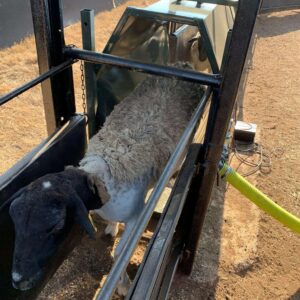
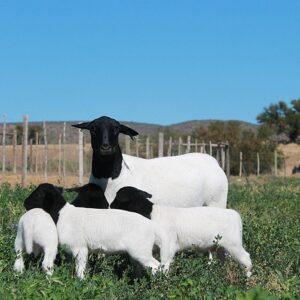
Black Head Dorper Sheep
Welcome to Hooggekraal Farms which is currently one of the longest-standing livestock exporters in Africa – with our expertise extending over three generations. We export quality dairy cows, beef cattle, Boer goats, Persian and Kalahari Goats as well as sheep throughout Africa and internationally.
A South African studbook was set up in 1906 and by the 1930’s there were 4000 registered animals. Black-headed Persian Sheep for sale.
The Persian was crossbred with local breeds and also “improved” though crossings with other breeds local to South Africa, including the Dorper. It was estimated that were around two million Persian Blackheads in South Africa by the 1950s.Persian sheep Characteristics
To the uninitiated breed is sometimes confused with goats. They are a type of hair sheep that do not grow wool, allowing them to better tolerate heat. The outstanding feature of Persian sheep is their colour and pattern. The breed comes in two basic varieties: harlequin (or speckled ) and kleur kop (which means ‘coloured head’).
Black-headed Persian Sheep
Facts about the Persian Sheep:
The pattern on each sheep is unique and can be black, brown, red, tri-colour or blue.
The kleur kop or coloured head is entirely white, except for the head which can be either black, brown, red, tri-colour or blue.
In 1955, my late father Joe Scher started a dairy farm in the Western Cape, where we milked more than 500 cows three times a day.
We then started large exports of dairy cows to the DRC (Congo) and Namibia (South West Africa) followed by Malawi, Botswana, Lesotho, Swaziland and Uganda, among others.
We offer the following:
– Quality animals
– Decades of experience in livestock exports
– Quarantining of animals according to veterinary import permit standards and requirements
– Transport to destination
Raised primarily for meat
Very healthy breed and with the ability to put on fat in tough grazing conditions
No lambing problems
Even temperament
Low water intake
Effective foraging ability
High quality soft leather (known as Cape glover)
Excellent mother line for crossbreeding
Ability to breed every eight months and to produce a high number of twins
Ewes lactate for approximately 84 days, produce 50 kg (110 lb) of milk with 5.9% fat